PayFac vs Merchant of Record: Understanding the Difference Before You Scale Globally
For many digital businesses, the first payment decision is surprisingly simple. You need a provider that can process cards, support the markets you want to sell in and offer an API your developers won't hate working with. At that stage, almost every conversation revolves around checkout performance, transaction fees and how quickly you can start accepting payments.The picture changes as soon as your business begins attracting customers from different parts of the world. Expanding internationally introduces an entirely new layer of responsibilities that has very little to do with authorising a card payment. Questions about VAT registrations, sales tax, invoicing requirements, consumer protection rules and cross-border compliance suddenly become just as important as payment acceptance itself, which is why companies that initially compared payment providers often find themselves comparing completely different business models a year later.
This is exactly where the distinction between a Payment Facilitator and a Merchant of Record becomes important. Both make online commerce easier, but they do so in fundamentally different ways, and choosing the wrong model early on can leave a growing business rebuilding its payments infrastructure much sooner than expected.
The biggest misconception about PayFacs and Merchant of Record providers
One of the reasons these two models are so often confused is that they both sit between the merchant and the customer during checkout. From the outside, the payment journey can look almost identical. The customer enters their card details, the transaction is authorised and the purchase is completed without ever seeing the commercial structure operating behind the scenes.
What happens after that payment is where the two models begin to diverge.
A Payment Facilitator gives businesses access to acquiring infrastructure without requiring every merchant to negotiate directly with acquiring banks. It simplifies onboarding, removes much of the traditional complexity around merchant accounts and allows companies to begin accepting payments much faster than they could under the conventional acquiring model.
A Merchant of Record is solving a different problem altogether. Instead of simply providing payment infrastructure, it becomes the legal seller for the transaction and assumes many of the obligations that normally remain with the merchant, including indirect-tax management and a significant part of the operational framework required to sell internationally.
That distinction may sound subtle on paper, but it changes who carries responsibility for almost everything that happens once the customer has clicked Pay.
A Payment Facilitator gives you the building blocks
The PayFac model has become enormously popular because it removes friction from the early stages of building an online business. Instead of spending weeks or months establishing direct merchant accounts and integrating several banking relationships, companies can begin processing payments through an existing payments platform almost immediately.
For many businesses, that is exactly the right approach.
A company that wants complete ownership of its payments operation can decide which fraud tools to use, which billing platform fits best, how payments should be routed, which tax software to integrate and how customer reporting should be structured. Every component can be selected independently, allowing the business to optimise each part of the stack as it grows.
That flexibility comes with an obvious trade-off. The more control you retain, the more operational responsibility remains inside your business. Expanding into new countries often means adding new software, new compliance processes and, eventually, new specialists whose job is to keep those systems working together.
For organisations with dedicated payments, finance and tax teams, that investment often makes perfect sense because payments are viewed as a strategic capability rather than simply another operational function.
Why many businesses eventually outgrow a PayFac-only approach
Companies rarely replace a Payment Facilitator because it stops processing payments effectively. More often, they discover that payments were only one part of a much larger operational challenge.
Imagine a SaaS company that launches in the UK and quickly gains customers throughout Europe, North America and Asia-Pacific. The payment platform continues to process transactions exactly as expected, yet the finance team suddenly finds itself researching VAT registrations, comparing tax engines, implementing subscription software, reviewing fraud providers and trying to reconcile information across several independent systems. None of those projects existed when the company processed its first hundred transactions, but they become increasingly difficult to avoid once revenue starts arriving from dozens of jurisdictions.
What initially looked like one payment provider gradually becomes an ecosystem of separate products, each solving a specific problem while adding another integration, another invoice and another operational dependency.
That doesn't mean the PayFac model is flawed. It simply means it was designed to solve payment acceptance, not every commercial obligation that comes with international growth.
A Merchant of Record takes ownership of the transaction itself
The Merchant of Record model starts from a completely different premise.
Rather than asking how merchants can assemble the right combination of payment infrastructure, tax software and compliance tools, it assumes that many businesses would prefer not to own those responsibilities in the first place.
Because the Merchant of Record becomes the legal seller, it can process transactions under its own commercial framework, calculate and collect applicable indirect taxes, fulfil the associated filing obligations and manage much of the operational complexity surrounding international sales. The merchant remains responsible for building the product, marketing it and supporting customers, but no longer needs to operate every administrative process that exists purely because the business sells into multiple jurisdictions.
For fast-growing digital companies, that difference becomes increasingly valuable over time. Expanding into another country no longer means building another layer of operational infrastructure because the Merchant of Record has already established that framework.
Payment Facilitator | Merchant of Record | |
Accepts customer payments | ✓ | ✓ |
Provides payment infrastructure | ✓ | ✓ |
Acts as the legal seller | No | Yes |
Calculates VAT, GST and sales tax | Sometimes, through separate products. | Included. |
Files tax returns | Merchant responsibility. | Included. |
Remits collected taxes | Merchant responsibility. | Included. |
Manages international tax compliance | Merchant responsibility. | Included. |
Best suited for | Businesses building their own commerce stack. | Businesses outsourcing international commerce operations. |
Where Number X fits
Number X was built for businesses that have already recognised a simple reality: accepting payments has become relatively straightforward, while operating an international digital business has become considerably more complex.
Instead of asking merchants to combine a Payment Facilitator with separate billing software, tax engines, filing providers and compliance tools, Number X brings those responsibilities together under a full Merchant of Record model. As the legal seller for every transaction processed through the platform, Number X manages indirect-tax compliance alongside payment processing, allowing merchants to expand internationally without creating an increasingly complicated operational stack behind the scenes.
This approach is particularly well suited to companies whose products are likely to evolve over time. A SaaS platform may introduce usage-based billing, an AI company may launch prepaid credits, and a mobile application may add in-app purchases or virtual goods. Each of those changes introduces new commercial considerations, but they shouldn't require a business to redesign its entire payments architecture every time the pricing model changes.
Number X supports SaaS, AI products, mobile applications, online games, in-game currencies, virtual items and other forms of digital commerce within the same Merchant of Record relationship, making it a practical choice for companies whose long-term roadmap extends beyond a single subscription product.
The commercial model is equally straightforward. Rather than layering separate charges for payments, tax management and additional operational products, Number X uses transparent pricing of 5% plus $0.50 per successful transaction, making it easier for finance teams to forecast costs as the business grows internationally.
Which model is right for your business?
The answer depends less on your current payment volume than on the kind of organisation you want to build over the next several years.
If your strategy is to own every part of the payments operation, negotiate directly with providers, choose specialist software for each operational function and maintain complete control over compliance, then a Payment Facilitator provides an excellent foundation. Many successful technology companies follow exactly that path because they have both the resources and the internal expertise to support it.
If, however, your competitive advantage lies in building products rather than operating global payment infrastructure, a Merchant of Record often represents the more efficient approach. Instead of investing time and resources into assembling an increasingly complex commerce stack, your team can continue focusing on engineering, product development and customer acquisition while the operational side of international selling is managed by a specialist provider.
Ultimately, the choice isn't between two different ways of processing payments. It's a decision about where responsibility should sit as your business grows, and whether your company wants to own the operational complexity of global commerce or delegate it to a partner whose business has been built around solving exactly that problem.

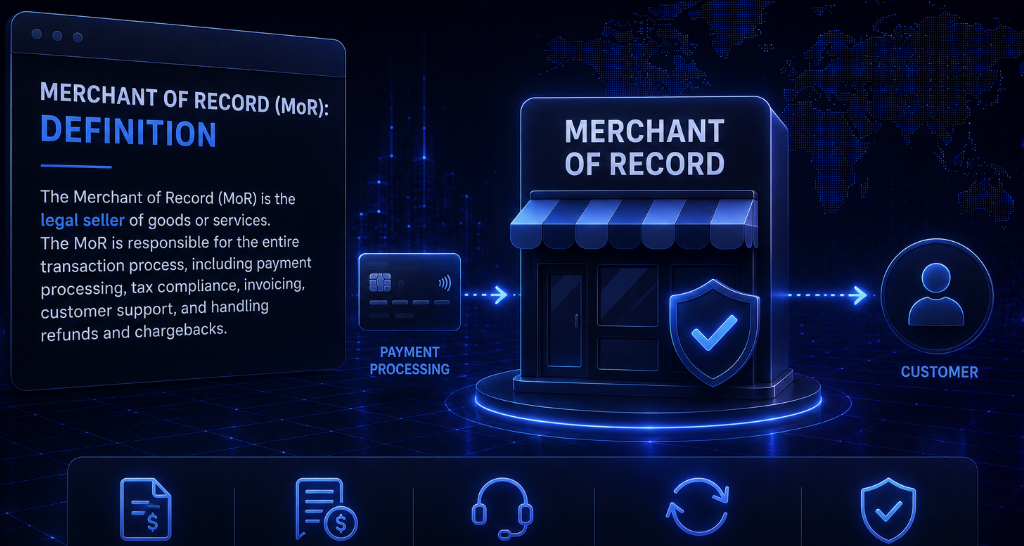
- Merchant of record (MoR): definition8 min read / July 23, 2026
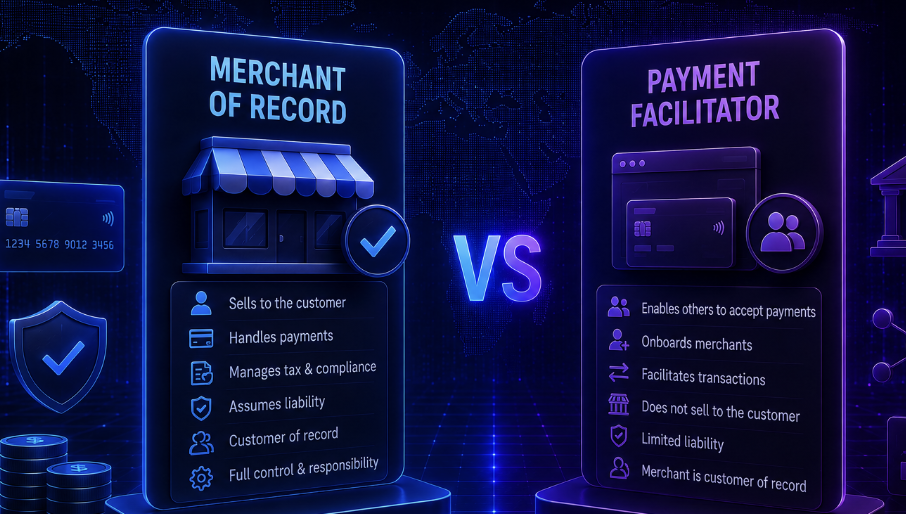
- Merchant of Record vs Payment Facilitator: What Is the Difference6 min read / July 23, 2026
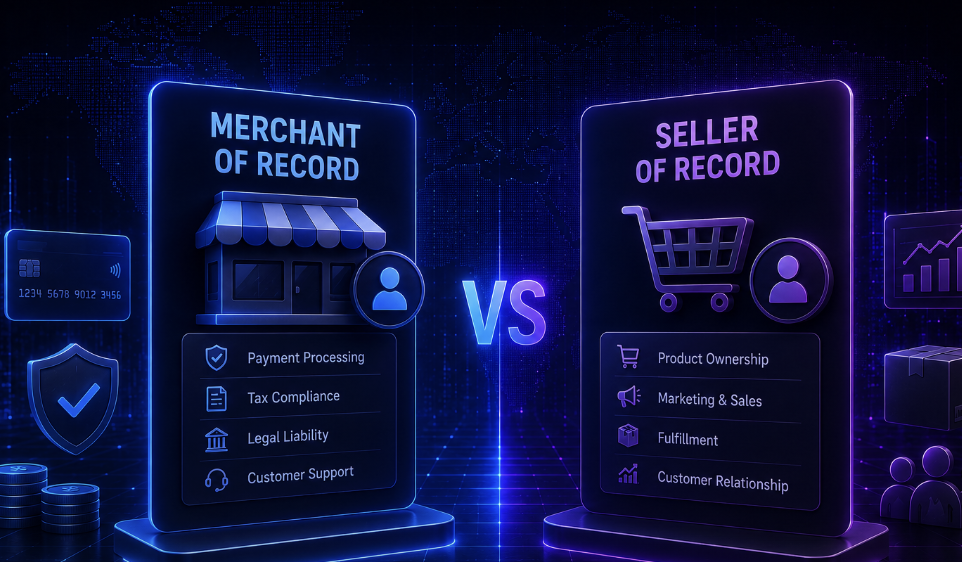
- Merchant of Record vs Seller of Record: What is the difference7 min read / July 23, 2026
- What Is the Merchant Business Model?5 min read / July 23, 2026