What is an abandoned cart
What is shopping abandoned cart. Why do customers abandon carts. What does it mean for businesses. How to reduce basket abandonment: methods and strategies. Shopping cart recovery: emails and retargeting.An abandoned cart is a situation when a person has put items into an online shop’s shopping cart, but has not finished the checkout. The issue of abandoned baskets is typical of e-commerce. According to the Baymard Institute, over 70% of online shop visitors cancel their purchases. Competent work with abandoned baskets helps businesses return buyers and increase conversion to sales.
What is an abandoned cart and how to deal with this problem — read in our article.
Common reasons for shopping cart abandonment
A forgotten or abandoned cart is a typical scenario of user behavior in an online shop. This term refers to situations when customers fill their shopping carts on the site with goods, but then quit the resource without completing the action. This is the behavior of two out of three visitors.
Behind every incomplete purchase is lost profit and an unsatisfied potential customer. The user was initially interested in ordering the selected products, but then changed their mind. There are a number of reasons why users leave abandoned carts.
Technical problems
Most often these are problems with the site. Technical failures, errors, long loading pages, non-adapted layout, inconvenient interface and navigation, constantly pop-up adverts — any of these defects encourage users to close the site and look for the goods they need in a different place.
Price
A large number of online shops allow customers to choose products at the most attractive prices. If a user puts an item into the basket, but then finds the same item at a lower price, they will definitely give up the desire to place an order in an expensive marketplace.
Shipping costs
Abandoned carts often happen when detailed information about delivery appears only at the stage of placing an order. For example, a person expected free delivery, but then it turned out that they had to pay extra for it. The total cost of the order appeared to be higher than planned, and the user decided not to buy the product or to order it from another shop.
Delivery time
Timing and delivery methods are also important to customers. If a user is not satisfied with any of these parameters, they will most likely refuse to buy.
Complicated payment process
If a customer has to follow different links (e.g., to the websites of online shopping partners), enter various codes, and provide personal information in order to pay for the shopping basket, they are likely to leave their cart abandoned.
Lack of trust
A client can lose trust in an online shop for various reasons: suspicious payment methods, shortage of customer reviews, negative reviews, poor quality content on the site (errors in the text, blurred images, outdated design), and so on.
Shortage of payment options
Difficulties with payments can discourage a customer from making a purchase. The user may abandon the cart and leave the shop if the site does not have the required payment option. For example, it is more convenient for a person to pay with an e-wallet, but only bank card payments are available in the shop. Or the customer does not have enough money and the shop does not offer installments.
No discounts or promo codes
There is a category of buyers who wait for prices to go down. Such people know exactly when brands sell off the rest of their collections at the end of the season and when holiday sales, Black Fridays, and other promotions start. Such users usually keep track of price changes in order not to miss favorable offers and not to run into a fake discount.
Ambiguous return and refund policy
Customers have no guarantee that a product bought online will fit them. If the purchase is difficult or expensive to return, the user will doubt the necessity of the transaction.
Comparison shopping
In this case, the user is not ready to buy here and now, and forms a basket for the future: to get to know the product better, to compare it with competitors’ offers, to orient themselves by budget. After a while, the client can return to the shop and place an order, or they can buy the same item elsewhere.
How to reduce cart abandonment
It is impossible to completely solve the problem — there will always be incomplete purchases. The percentage of abandoned carts can only be reduced through specific actions.
Analytics
To optimize the site and amend the shopping experience, it is necessary to constantly study the target audience, test new interface elements and customer reactions. If the percentage of abandoned carts is high, it is important to understand at what stage users leave the site or app. This will help build a hypothesis and correct the situation.
Use analytics services, run regular marketing surveys, and ask customers what caused them to abandon a purchase.
A/B testing
A/B testing is a research method that allows you to find out how people react to changes in an advertising campaign or website, for example, to evaluate which ad headline attracts users more or how the color of a button affects the number of clicks.
A/B tests are used:
In online advertising. They help businesses compare different variants of advert settings.
In email marketing. Testing allows companies to select those variants of emails that encourage recipients to open and read them.
When optimizing a website or mobile application. A/B-tests can suggest which variant of a web page or screen will bring more visitors and applications, as well as make the site more convenient.
The method is suitable for anyone who is working on improving the quality of a product and wants to analyze user behavior. Testing reveals which elements on a website or in an online shop application attract users and which ones repel them. In the future, you will be able to create projects taking into account the preferences of potential customers.
You can use special services, such as Optimizely Web Experimentation, to conduct A/B testing.
Trust increasing
Increase the trust of the audience. Make users confident in the reliability of your company. For this, you can:
add product quality certificates and copies of constituent documents to the site;
publish company contacts (phone number, email, physical address);
tell the story of the brand, add photos of the team;
motivate customers to publish product reviews and share real photos.
Take care of convenient and secure payments. Allow users to pay in different ways:
with bank cards;
using e-wallets;
through banking services;
upon receipt (cash or cashless);
in instalments.
Make payments safe and easy for users, without the necessity to specify lots of personal data and fill out many online forms.
Other options
There are other opportunities to reduce the percentage of shopping cart abandonment:
Make your shopping basket convenient. Get rid of all the optional fields and simplify editing. Leave important information about discounts, product parameters, and order amount on the screen. Make sure users see all the details they may need to make a purchase.
Simplify order placement. Remove mandatory registration and add login via social networks or browsers. Reduce the authorisation form: leave only email, password, and (or) phone number. All this will allow the customer to quickly place an order in a couple of clicks.
Develop a return policy. Calculate the costs associated with returns and work out optimal conditions. To decrease the number of abandoned carts, it’s better to make this option free and speed up the return transfer of money. Place this information in the basket, product card, and a special block on the website or in an app.
Work out the delivery issue. Users should know the shipping terms before they add a product to the basket. Tell about the methods, terms, and costs in a separate section and (or) in the product card. This way you will save your customers from surprises. Maximize delivery options: by post, courier, self-delivery, transport company. Reduce the cost or deliver goods for free (you can include this service in the product price).
Work on usability. Monitor page loading speed, regularly check the site and app for errors. Repeat the user’s path from login to purchase — this way you can make sure that everything works correctly and the process is simple and convenient. Be sure to adapt the site for mobile devices, monitor the quality of images, literacy of text, and relevance of information.
Number X will help your business grow and develop avoiding issues with taxes and payments. You can focus on website improvement, efficient ads campaigns, and building of trust among customers, while we will register, collect, and remit your taxes, optimize cross-border payment conversion, and ensure compliance with all laws and regulations. Click here to join 2,000 merchants that partner with Number X.
Shopping cart recovery
If a customer does leave the site and abandon the shopping basket, use return mechanics. They will help you “catch up” with the departed user and make him or her complete the transaction.
Abandoned cart emails
Set up a trigger newsletter with a reminder of a forgotten item and a call to purchase. Incentivise the customer with discounts, promo codes, and limited offer triggers.
You can send emails to the customer, or you can send push notifications. They pop up in the browser or the smartphone unless the user has disallowed them in the settings. Trigger “pooches” about an abandoned cart are usually sent a few hours after a person has left the site or app.
SMS messages are used if the customer’s phone number is available. Prepare a short reminder about the abandoned cart and add a link so that the user can immediately go to the desired section.
You can also add messenger mailings. This method is available if you have a phone number of your customer or if the person placed an order in a chatbot.
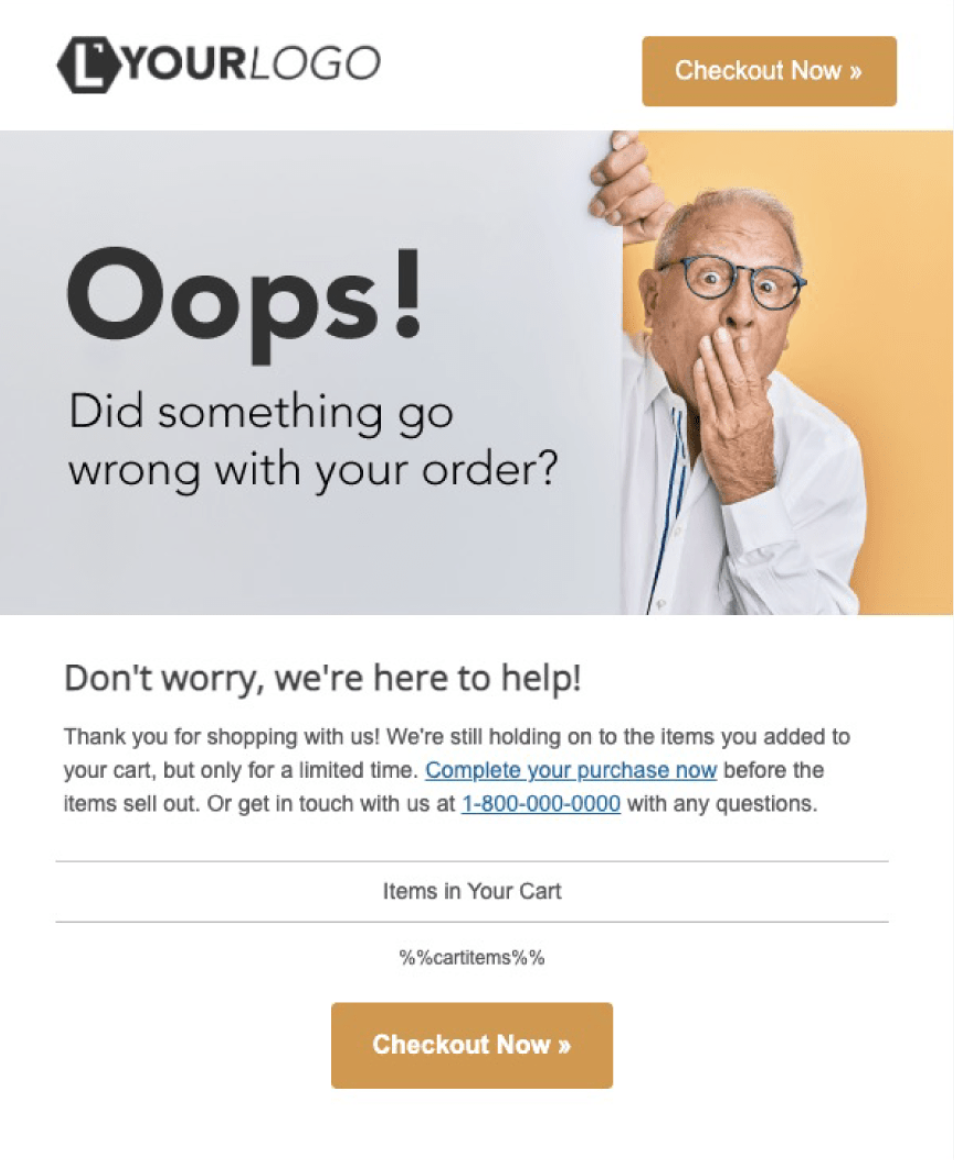 An abandoned shopping cart template from CartStack
Abandoned cart retargeting
Set up advertising based on cookies and show the customer the goods from the basket on third-party sites, for example, in Google or social networks. Offer a bonus at checkout, such as free delivery, or a discount.
By reminding customers of their abandoned carts, businesses can significantly increase the likelihood of completing the sale, as these users are already familiar with the products. They might change their mind about purchasing the selected product due to the discount or better shipping conditions.
Besides, retargeting keeps the brand at the forefront of the consumer’s mind, enhancing brand awareness and recognition. This is particularly important in competitive markets.
Conclusion
An abandoned cart is a situation when a person added items to the basket of an online shop, but did not complete the purchase.
According to statistics, two out of three customers leave their shopping baskets. You can not avoid this problem, but you can minimize it significantly.
The reasons for this can be different, from unsuitable delivery conditions to lack of trust in the seller.
Website or app optimisation, mailings and retargeting can help reduce the percentage of incomplete transactions.
To bring down the shopping cart abandonment level, improve your website interface, perform A/B testing, and increase the reliability of your business.

- Merchant of record (MoR): definition8 min read / July 23, 2026
- Merchant of Record vs Payment Facilitator: What Is the Difference6 min read / July 23, 2026
- Merchant of Record vs Seller of Record: What is the difference7 min read / July 23, 2026
- What Is the Merchant Business Model?5 min read / July 23, 2026