Merchant of Record vs Payment Gateway: What's the Difference?
Learn the difference between a Merchant of Record and a payment gateway, including their roles in online payments, compliance, tax management, and global digital commerce.The terms Merchant of Record and Payment Gateway are often used interchangeably, particularly by founders launching their first digital product. Both are involved in online payments, both sit somewhere in the checkout flow and both help merchants accept money from customers.
In reality, they solve entirely different problems.
A payment gateway is one component of a payments stack. Its primary role is to securely transmit payment data between the customer, the acquiring bank and the payment processor. A Merchant of Record, by contrast, is an end-to-end commerce solution that becomes the legal seller, processes payments, manages indirect taxes, handles compliance and assumes many of the operational responsibilities that come with selling digital products globally.
Understanding the distinction matters because businesses often start by looking for a payment gateway, when what they actually need is an infrastructure capable of supporting international growth.
What is a payment gateway?
A payment gateway is the technology layer that securely captures payment information and forwards it for authorization. You can think of it as the bridge between your checkout page and the wider payments ecosystem.
Most modern gateways provide a dashboard where merchants can view transactions, issue refunds, monitor payment status and generate basic reports. Some also include APIs, webhook support and fraud-screening features, but their core responsibility remains the same: moving payment information from the customer to the financial institutions responsible for authorizing the transaction.
A payment gateway does not process the payment itself. It also doesn't settle funds, collect taxes or become responsible for the transaction. To build a complete payments infrastructure, merchants typically need additional providers such as:
An acquiring bank
- A Payment Service Provider (PSP)
- A Payment Facilitator (PayFac)
- Fraud prevention software
- Subscription billing software
- Tax calculation software
- Tax filing and remittance services
The gateway is simply one layer within that broader stack.
Why payment gateways aren't enough for international businesses
A payment gateway is perfectly adequate for businesses that already have the rest of their payments infrastructure in place.
Large enterprises often negotiate their own acquiring agreements, operate dedicated payments teams and integrate specialist providers for billing, fraud prevention, reconciliation and tax compliance. In that environment, the gateway performs exactly the role it was designed for: securely routing payment information between systems.
The experience is very different for a growing SaaS company or AI startup expanding internationally.
Accepting the payment is rarely the difficult part. The real complexity begins once customers arrive from twenty, thirty or fifty different countries, each with different VAT rules, payment regulations, consumer protection requirements and reporting obligations. A payment gateway offers almost no help with those challenges because they sit outside its intended scope.
As a result, businesses often discover that their "payments solution" has quietly evolved into half a dozen different vendors connected together by custom integrations and internal operational processes.
What is a Merchant of Record?
A Merchant of Record takes a fundamentally different approach.
Instead of providing one component of the payments stack, the Merchant of Record becomes the legal seller for every transaction processed through its platform. That allows it to assume responsibilities that would otherwise remain with the merchant, including payment processing, indirect-tax management, chargeback handling and a significant part of the compliance framework required for international commerce.
Rather than asking merchants to combine a gateway, PSP, tax engine, billing platform and filing provider, the Merchant of Record brings those functions together under a single commercial relationship.
From the merchant's perspective, the difference is significant.
Instead of spending time assembling and maintaining payment infrastructure, the business integrates with one platform that manages the commercial side of selling internationally while the merchant focuses on building products and acquiring customers.
Payment gateway vs Merchant of Record
Feature | Payment Gateway | Merchant of Record |
Secure payment data transmission | ✓ | ✓ |
Transaction dashboard | ✓ | ✓ |
Payment processing | Requires a PSP, PayFac or acquirer. | Included. |
Acquiring relationship | Merchant must arrange separately. | Included. |
Legal seller | Merchant. | Merchant of Record. |
VAT, GST and sales tax calculation | No. | Included. |
Tax filing and remittance | No. | Included. |
Chargeback management | Limited tools. | Included. |
International compliance | Merchant responsibility. | Included. |
End-to-end commerce solution | No. | Yes. |
Building your own payments stack
One advantage of working with a payment gateway is flexibility.
Merchants can choose exactly which acquiring bank they want to use, negotiate directly with PSPs, integrate specialist billing software and replace individual components whenever commercial requirements change. Businesses with experienced payments teams often prefer this model because it gives them complete control over their infrastructure.
The downside is that every additional capability usually means adding another provider.
A typical international software company might use one vendor for the payment gateway, another for payment processing, a third for subscription billing, a separate tax engine to calculate VAT, another provider to file tax returns and additional software for fraud prevention. None of these products is inherently problematic, but together they create an increasingly complicated payments architecture that must be integrated, monitored and maintained.
That complexity grows alongside the business.
Launching in another country often means adding more tax registrations, more compliance work and more operational processes rather than simply accepting another payment method.
Why many digital businesses choose a Merchant of Record instead
The Merchant of Record model appeals to businesses that would rather avoid building that infrastructure themselves.
Instead of selecting individual components one by one, merchants work with a single provider responsible for the commercial transaction from checkout through settlement, tax remittance and compliance.
This doesn't eliminate the underlying complexity of international commerce. It changes who is responsible for managing it.
For startups and growth-stage companies, that distinction can make a meaningful difference. Engineering teams spend less time integrating specialist software, finance teams avoid maintaining tax registrations across multiple jurisdictions and founders can expand into new markets without turning every international launch into a separate operational project.
Where Number X fits
Number X was designed as a full Merchant of Record rather than a payment gateway.
The platform combines payment processing, international acquiring, indirect-tax management and compliance within a single solution, allowing merchants to sell globally without assembling a separate payments stack behind the scenes.
This approach is particularly relevant for digital businesses whose products and pricing models continue evolving over time. A company may start with a straightforward SaaS subscription before introducing AI usage credits, in-app purchases, virtual items or recurring memberships. Each new revenue stream creates additional operational complexity, yet it shouldn't require replacing the entire commerce infrastructure.
Number X supports SaaS, AI products, mobile applications, online games, in-game currencies and other digital goods within the same Merchant of Record framework, giving businesses the flexibility to expand their commercial model without continually adding new payments vendors.
Its pricing is equally straightforward: 5% plus $0.50 per successful transaction, covering far more than payment acceptance alone. Instead of paying separately for a payment gateway, payment processing, tax management and other operational services, merchants work with one provider responsible for the complete transaction lifecycle.
Choosing the right model depends on what you're building
A payment gateway is an excellent choice when your business already has the resources to build and manage its own payments operation. Large enterprises with dedicated payments, finance and tax teams often prefer that level of flexibility because they can optimise every component independently.
A Merchant of Record is designed for a different objective. Rather than giving merchants another building block, it provides a complete commerce infrastructure that removes much of the operational burden associated with selling internationally.
For businesses whose competitive advantage lies in developing software, AI products, mobile apps or games—not in operating payment infrastructure—the Merchant of Record model often proves to be the faster, simpler and more scalable approach.

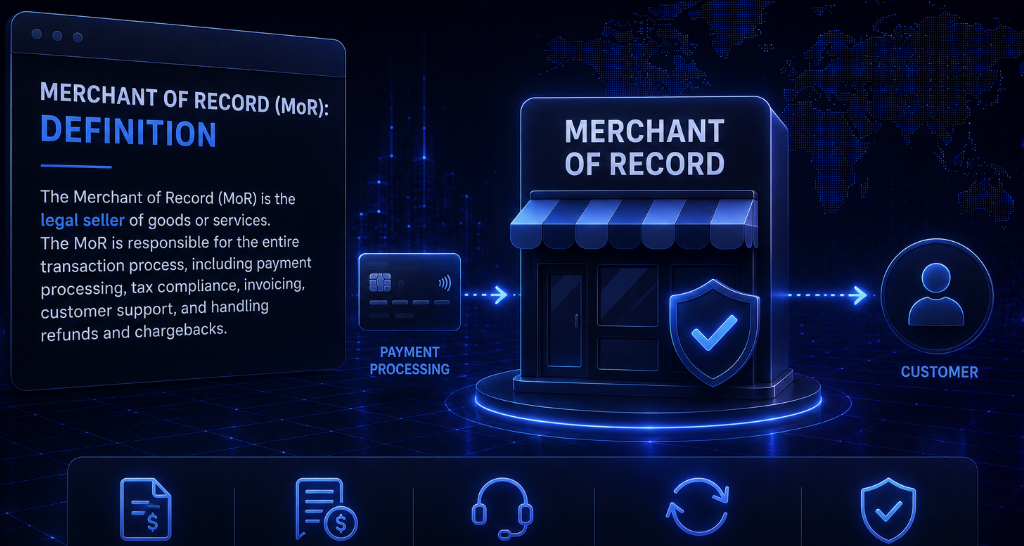
- Merchant of record (MoR): definition8 min read / July 23, 2026
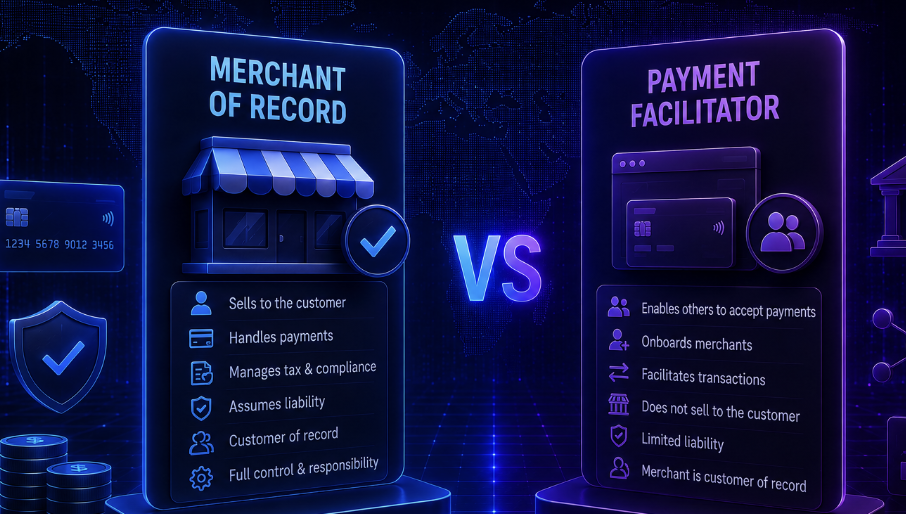
- Merchant of Record vs Payment Facilitator: What Is the Difference6 min read / July 23, 2026
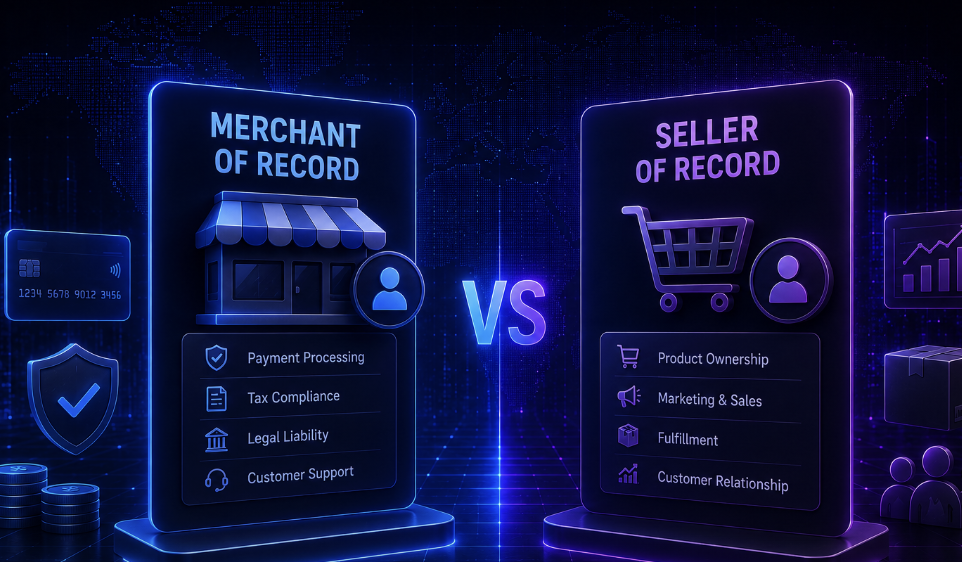
- Merchant of Record vs Seller of Record: What is the difference7 min read / July 23, 2026
- What Is the Merchant Business Model?5 min read / July 23, 2026